
Consciousness might’ve been a tragic misstep in human evolution, but how about self-consciousness? That, to me, is the avenue worth exploring, and what better topic for it than artificial intelligence(!).
Okay, here’s a simple thought experiment: with AI, I could draw up a plan for a house, right? An architect can do the same, but wouldn’t it be strange if I declared every architect redundant now that I have access to AI (as they do)? Is there any scenario where this unwarranted complacency could have me lying in bed, hoping the creaking from the ceiling doesn’t mean the wall I just knocked down in the fervor of my newfound competence was load-bearing?
We’ve already witnessed some tremendous things done with AI by people who never had the technical capability or financial means to bring their ideas to life. The bot allowed these things to materialize, but we shouldn’t be fooled. The THING didn’t whisper the ideas into the ears of the creators.
But the creators aren’t the confused ones. By the looks of it, there are swarms of people who deem the BASELINE (skills, taste, creativity, subject matter knowledge, intelligence) completely irrelevant. However, the audit always conveniently stops at their own doorstep. The agentic armies get to ram ahead, and the one thing that never gets questioned is the judgment of the biological being giving the orders. Did someone mention self-consciousness?
Separating the two very different concepts of ingenuity and slippity-slop seems impossible for those who are efficiency-inclined. The spark is innate. You can’t reverse engineer it, only replicate it. And replication isn’t creation.
What I can’t stomach, though, is the (seemingly) blind hypocrisy and self-serving opportunism that threaten to run quality into the ground by consolidating decision-making in the hands and minds of people who aren’t familiar with, or inclined toward, the craft in question. Cue the AI-generated commercial.
“It’s a commercial, isn’t it? I asked for a commercial, and it made one!? Well, yes, the technology’s not ready yet, but we saved a ton of money by dumping the creative agency and prompting it with my left hand, which until now was reserved for the art of Excel shortcuts. C’mon, it’s cheaper!”
But is it better than what the agency could’ve whipped up in tandem with Mr. Roboto?
“Well, it’s hard for me to see how these types of jobs will still exist, now that I’ve tinkered with these models and agents and blah-blah-blah.”
What about you, then? You think you’ll be saved by this messIAh because you were first in line? Didn’t you just say that the models get better day by day, that today’s tools are outdated tomorrow?
“YOU JUST DON’T GET IT!”
I don’t. Neither do most people using it. And to be clear, I use it. I’ll likely edit this thing with AI, and some of you will think this was written with AI, and that’s fine (I guess). There’s nothing I can do about it.
And I know it’s almost pointless to say this in the attention economy we live in (which I’m feeding by posting), but I’ll go ahead anyway: I don’t hate AI, because I don’t think it’s something that can be labeled good or bad, black or white, or reduced to childish yin & yangisms. But it should be discussed with the uncertainty it deserves.
Understanding the craft will matter more than ever. Understanding why we do things in the first place will matter even more, no matter how much you prompt and how many compliments you get for ideas you never had.
Here’s an ad I made in five seconds that has more soul than the car-ad goo out there.
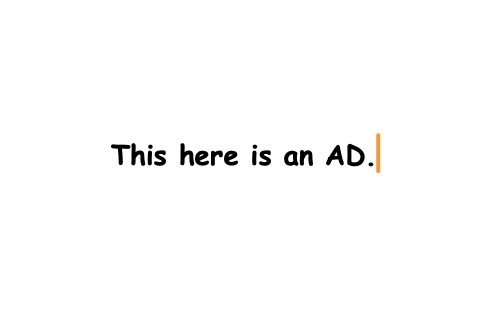
Or would you prefer it with some extra-hot nacho cheese dripping over steampunk aesthetics? “That’s cool, isn’t it? I specifically asked IT to make it cool, man! Now make a car do a kickflip!”